
Them vs Us
- Format
- Static, Video
- Category
- Comparison & Positioning
- Stage
- MOF
- Requires
- Named competitor
What is it
An ad that picks a villain and beats it. The villain is usually the old way of doing something, a category habit, or a generic competitor. You show it failing, then show yours working, and let the comparison make the decision obvious.
What makes it work
Pick a villain people already dislike.
A lint roller that clogs. A hard drive the size of a brick. Sugary energy drinks. You're borrowing an annoyance the viewer already has, so it has to be one they recognise instantly.
Run the same test on both.
Same surface, same action, same moment, ideally side by side. The comparison only lands when it's obviously fair. Two different demos is just two claims.
Use a physical consequence.
Water spilling on the wobbly desk. Hair clogging the roller. Powder going clumpy. Something visible failing beats any adjective about quality.
Mark it up for muted viewing.
Red X and green tick, colour for you and greyscale for them, labels on both sides. People should be able to tell who's winning from a single frame with no sound.
Land the risk reversal.
These ads get aggressive, and aggressive invites skepticism. Close with the guarantee, the test data, the review count. The logic has to end somewhere safe.
Make the dividing line unmissable.
A VS badge, a hard color split, or "US / THEM" headers. The brain likes binary choices because they take less effort, but only if the split is obvious in the thumbnail before a word is read.
Let the "Them" side look worse.
Red X's, greyed-out bottles, dull backgrounds, a higher price. The eye collects the pain points first, so the "Us" side, with green checks, bright color, and a clean layout, feels like relief.
Choose the enemy deliberately.
"Other brands," "cheap satin," a blank grey bottle, or "the old way" is the safe default and often creates a stronger identity shift. A named competitor is more disruptive, but in DACH it falls under UWG §6: the comparison has to be objective, verifiable, and not disparaging. Get legal sign-off before naming anyone.
Every red X is a factual claim.
Anything you put on the "Them" side has to be true and provable. A hook like "are you getting ripped off?" turns a comparison into disparagement, and competitors file lawsuits over that faster than regulators act.
Pick one axis to win on.
Price, performance, values, or convenience. A table where every feature ties and only the price row changes can build more trust than a stacked scorecard.
Keep the demo fair.
When the difference is shown on a person, keep their expression the same on both sides so the product is the only variable. A frown next to a smile stacks the deck and reads as manipulation.
Reference 1
AI Edit Master Prompt
Produce a {DURATION} vertical 9:16 UGC-style product demonstration ad for {PRODUCT}.

Generate the following sequence:

The Hook (Size Comparison): A {SPOKESPERSON_PERSONA} in a {WORKSPACE_SETTING} holds up the small {PRODUCT} in one hand. In the other hand, they lift a {BULKY_COMPETITOR_PRODUCT} (e.g., an old, large hard drive), stating the smaller one has more capacity.

The Demonstration: The spokesperson explains the {CORE_SPECS} (e.g., 2TB solid-state portable flash drive). They hold up a {COMPATIBLE_DEVICE} (e.g., a smartphone) and demonstrate the {KEY_FEATURE} (e.g., magnetic attachment and USB-C connection), emphasizing the convenience.

The Value Proposition: The spokesperson holds the {PRODUCT} and delivers a {SCARCITY_HOOK} or {PAIN_POINT_QUESTION} (e.g., "What if the internet goes down?"). They present the {PRODUCT} as the reliable solution.

The Price & CTA: The spokesperson rests the {PRODUCT} on top of the {BULKY_COMPETITOR_PRODUCT} to reiterate the size difference. They emphasize the {PRICE_POINT} and deliver a strong {CALL_TO_ACTION} pointing to the on-screen purchase link.

Assemble: A continuous, single-take, straight-to-camera UGC edit. The camera remains static, relying entirely on the creator's engaging delivery and the physical manipulation of the product and its bulky counterpart to keep the viewer's attention.

Text Overlay: No text overlays. Rely entirely on the creator's voiceover.

Audio: The creator's conversational, enthusiastic {VOICEOVER}. No background music, keeping the focus entirely on the creator's message.

End Card: No dedicated end card; the video concludes naturally on the final call-to-action shot, directing the user to the purchase button.
Reference 2
AI Edit Master Prompt
Produce a {DURATION} vertical 9:16 UGC-style product demonstration for {PRODUCT}. No dialogue.

Generate the following sequence:

The Setup: A top-down POV shot of a large amount of {MESS_TYPE} (e.g., pet hair) scattered on a clean {SURFACE_1} (e.g., a white bedsheet). A real {PET_OR_PROP} is lounging in the background.

The Ineffective Alternative: A hand brings in a {COMPETITOR_PRODUCT} (e.g., a standard lint roller) and struggles to clean the {MESS_TYPE}. The hand peels off a dirty, hair-covered layer of the roller, demonstrating its inefficiency.

The Product Reveal & Demo: The hand brings in the {PRODUCT} and smoothly sweeps it across the {SURFACE_1}, effortlessly removing the {MESS_TYPE} in a single pass. The hand then easily removes the collected {MESS_TYPE} from the {PRODUCT_CLEANING_SURFACE} to show how easy it is to clean.

The Versatility Montage: Quick cuts of the {PRODUCT} successfully cleaning {MESS_TYPE} off of {SURFACE_2} (e.g., a beige couch) and {SURFACE_3} (e.g., a light rug), followed by the satisfying action of removing the collected mess from the product each time.

Assemble: A fast-paced, highly satisfying "cleaning ASMR" edit. Focus on the smooth, effective movement of the product and the stark contrast between the messy and clean surfaces.

Text Overlay: No text overlays to keep the focus entirely on the visual demonstration.

Audio: A quirky, rhythmic {SOUND_BED} (e.g., a bouncy instrumental track). Include exaggerated {CARTOON_SOUND_EFFECTS} (e.g., squeaks, boings, pops) synced to the movements of the tools and the peeling of the mess to add a playful, engaging element. No voiceover.

End Card: No dedicated end card; the video concludes naturally on the final satisfying shot of removing the mess from the product.
Reference 3
AI Edit Master Prompt
Produce a {DURATION} vertical 9:16 UGC-style "Problem/Solution" ad for {PRODUCT}.

Generate the following sequence:

The Problem (Energy Drinks): A {SPOKESPERSON_PERSONA} in a {LIFESTYLE_SETTING} speaks directly to the camera. They critically examine a typical {COMPETITOR_PRODUCT} (e.g., an energy drink), overlaying text that highlights {NEGATIVE_INGREDIENT_1} and {NEGATIVE_INGREDIENT_2}. A quick, stylized {3D_ANATOMY_ANIMATION} shows the negative effect on the body (e.g., stomach upset).

The Solution (The Reveal): The spokesperson enthusiastically introduces {PRODUCT} by name, holding the {PRODUCT_PACKAGING}. A quick montage shows the {PRODUCT} being unboxed and prepared. The spokesperson lists what it doesn't have: {ABSENT_NEGATIVE_1} and {ABSENT_NEGATIVE_2}.

The Ingredients Walkthrough: A fast-paced sequence of macro shots highlighting the {KEY_INGREDIENTS} (e.g., functional mushrooms, maca root). As each ingredient is shown, the spokesperson briefly explains its {SPECIFIC_BENEFIT}.

The Lifestyle Transformation: The spokesperson explains the {CORE_BENEFIT} (e.g., sustained energy, no crash) and the {TASTE_PROFILE}. A split-screen or quick cut compares the spokesperson's past tired state (with the competitor product) to their current productive, focused state (with the {PRODUCT}).

The Final Pitch & CTA: The spokesperson reiterates the {CORE_BENEFIT} and delivers a clear {GUARANTEE_OFFER} (e.g., 60-day money-back guarantee). They deliver a strong {CALL_TO_ACTION} while holding the {PRODUCT_PACKAGING} and mentioning a specific {DISCOUNT_OFFER}.

Assemble: A high-energy, fast-paced direct-response edit. Blend talking-head UGC, macro ingredient photography, and relatable lifestyle B-roll. Use the "us vs. them" framing to establish a strong contrast between the competitor's negative effects and the product's positive benefits.

Text Overlay: Dynamic, center-screen {SUBTITLE_STYLE} captions synced word-for-word with the audio. Use bold text and checkmarks/X's to emphasize the contrast between the products.

Audio: The creator's energetic, authoritative {VOICEOVER} layered over an upbeat, driving {SOUND_BED}.

End Card: A clean, minimal screen with a solid {BRAND_COLOR} background displaying the {BRAND_LOGO}, a brief {TAGLINE}, an image of the {PRODUCT_BUNDLE}, and a prominent {CTA_BUTTON} at the bottom with social proof text (e.g., "200,000+ SOLD").
Reference 4
AI Edit Master Prompt
Produce a {DURATION} vertical 9:16 side-by-side comparison ad for {PRODUCT}. No dialogue.

Generate the following sequence:

The Speed Test: A split-screen shot. The left side shows {PRODUCT} and the right side shows {COMPETITOR_PRODUCT}. Both desks are shown adjusting their height. The {PRODUCT} moves noticeably faster.

The Cable Management Test: The split-screen shows the underside of both desks. The {PRODUCT} on the left has neatly organized cables in a {PRODUCT_FEATURE} (e.g., an integrated tray). The {COMPETITOR_PRODUCT} on the right has messy, tangled cables hanging down.

The Stability Test: The split-screen shows a glass of water on both desks. A hand pushes on the edge of each desk. The water on the {PRODUCT} desk barely ripples, while the water on the {COMPETITOR_PRODUCT} desk spills over.

The Control Test: The split-screen shows the control panels of both desks. A hand interacts with the {PRODUCT} panel on the left, demonstrating a fast, single-touch response. A hand interacts with the {COMPETITOR_PRODUCT} panel on the right, which is slow and unresponsive.

The Smart Features Test: The split-screen shows a smartphone on each desk. The {PRODUCT} on the left demonstrates its {SMART_FEATURE} (e.g., Bluetooth connectivity and app control). The {COMPETITOR_PRODUCT} on the right has no connectivity.

The Final Setup: The split-screen dissolves into a full-screen, aesthetic lifestyle shot of the {PRODUCT} fully set up as a comfortable, modern workspace.

Assemble: A fast-paced, highly visual side-by-side comparison edit. Maintain the split-screen format for the majority of the video to create a direct, unarguable contrast between the {PRODUCT} and the {COMPETITOR_PRODUCT}. The edits should be quick and rhythmic, moving rapidly from one feature comparison to the next.

Text Overlay: Use a clear, consistent {SUBTITLE_STYLE}. Each split-screen segment should have a header identifying the product (e.g., "{PRODUCT}" vs. "Generic Standing Desk") and a brief, contrasting text description of the feature being tested (e.g., "So Fast" vs. "So Slow"). The final shot should display a strong {SOCIAL_PROOF_CLAIM} (e.g., "Canada's #1 Favourite Sit Stand Desk").

Audio: An upbeat, modern {SOUND_BED} that drives the rhythm of the quick cuts. Include satisfying {SOUND_EFFECTS} (e.g., the smooth motor of the desk, the splash of the water) to enhance the visual demonstration. No voiceover.

End Card: A clean, minimal screen with a solid white background displaying the {BRAND_LOGO} in bold black text.
Reference 5
AI Edit Master Prompt
Produce a {DURATION} vertical 9:16 UGC-style "green-screen" review ad for a {LEAD_MAGNET} (e.g., a product comparison cheat sheet). No dialogue.

Generate the following sequence:

The Hook (Visual Contrast): A {SPOKESPERSON_PERSONA} in a {LIFESTYLE_SETTING} (using a green-screen or picture-in-picture effect) speaks directly to the camera. The background displays two contrasting {VISUAL_PROPS} (e.g., a bag labeled "Good Collagen" and one labeled "Bad Collagen"). The spokesperson asks a {HOOK_QUESTION} and lists the {TARGET_BENEFITS} (e.g., hair, skin, joints) the viewer desires.

The Problem & Solution Reveal: A bold {REPORT_HEADLINE} (e.g., "TOP 6 COLLAGEN") appears at the top of the screen. The background transitions to display a grid of {COMPETITOR_PRODUCTS}. The spokesperson addresses an {INDUSTRY_PAIN_POINT} (e.g., not all products are equal, wasting money) and introduces the {LEAD_MAGNET} as the ultimate time-saver, emphasizing a credible {DATA_POINT} (e.g., "tested 70+ brands").

The Curiosity Gap: The spokesperson uses an expressive tone to share a {SURPRISING_INSIGHT} (e.g., being shocked that luxury brands fell short), intentionally withholding the specific brand names to build a strong curiosity gap.

The Call to Action: A prominent {DIRECTIONAL_GRAPHIC} (e.g., a bouncing red arrow) appears on screen. The spokesperson delivers a direct {CALL_TO_ACTION} instructing the viewer to click the link to get the {LEAD_MAGNET} and see the winning brands.

Assemble: A direct-to-camera, informative UGC edit utilizing a "reaction" or "commentary" format. The visual background serves as a dynamic presentation slide, while the creator drives the narrative, builds credibility, and creates urgency. Keep cuts minimal, relying on the changing background graphics to maintain visual interest.

Text Overlay: Dynamic, easy-to-read {SUBTITLE_STYLE} captions synced word-for-word with the audio. Use a prominent, static {HEADLINE_BANNER} during the solution reveal to clearly state the video's value proposition.

Audio: The creator's conversational, authoritative {VOICEOVER}. Keep background audio minimal or use a very subtle {SOUND_BED} to ensure the spoken information is the primary focus.

        End Card: No dedicated end card; the video concludes seamlessly on the final call-to-action shot with the directional graphic pointing toward the caption or link.
Reference 6
AI Edit Master Prompt
Produce a {DURATION} vertical 9:16 UGC-style product review ad for {PRODUCT}.

Generate the following sequence:

The Hook: A {MODEL_PERSONA} in a {LIFESTYLE_SETTING} takes off an uncomfortable, traditional {COMPETITOR_PRODUCT} with a sigh of relief. The text overlay reads: "Goodbye old {COMPETITOR_PRODUCT}."

The Reveal: The {MODEL_PERSONA} turns to reveal she is wearing the {PRODUCT} and smiles. The text overlay introduces the {PRODUCT_NAME} as the "modern {PRODUCT_CATEGORY}."

The Feature Breakdown: A series of close-up, tactile shots demonstrating the {PRODUCT_FEATURES}:

Feature 1: A split-screen compares the flexibility of the {PRODUCT}'s {KEY_FEATURE_1} (e.g., wire-free design) against a rigid {COMPETITOR_PRODUCT}.

Feature 2: A close-up of fingers pressing into the {PRODUCT_MATERIAL}, highlighting its {MATERIAL_BENEFIT} (e.g., soft, buttery fabric).

Feature 3: A shot of the {MODEL_PERSONA} adjusting the {ADJUSTABLE_FEATURE} (e.g., straps) to show the {FIT_BENEFIT} (e.g., perfect fit).

Feature 4: A close-up of the {PRODUCT_INNOVATION} (e.g., inner cushion), with animated line graphics highlighting how it enhances {DESIRED_OUTCOME_1} (e.g., natural shape).

The Before & After: A side-by-side or top-and-bottom comparison shot showing the {MODEL_PERSONA} wearing a tight t-shirt. The "Before" shot shows the {COMPETITOR_PRODUCT}, and the "After" shot shows the {PRODUCT}. Animated arrows highlight the {DESIRED_OUTCOME_2} (e.g., gentle lift).

The Final Pitch: The {MODEL_PERSONA} speaks to the camera, praising the {PRODUCT} for not being "too much" while still delivering results. She ends with a playful {CATCHPHRASE} (e.g., "my boobs are going only one way... UP").

The CTA: A final shot of the {MODEL_PERSONA} posing confidently while the {BRAND_LOGO} and a {CALL_TO_ACTION} appear on screen.

Assemble: A fast-paced, highly visual UGC edit. Blend relatable lifestyle shots with extreme close-ups of the product's fabric and construction to emphasize comfort and innovation. Use the before-and-after comparison to provide clear, visual proof of the product's claims.

Text Overlay: Clean, aesthetic {SUBTITLE_STYLE} captions. Use bold text to highlight the {PRODUCT_NAME} and {KEY_FEATURES}. Include subtle animated graphics (like lines and arrows) to draw attention to specific benefits during the feature breakdown and comparison sections.

Audio: The creator's conversational, relatable {VOICEOVER} layered over an upbeat, trendy {SOUND_BED}.

        End Card: The final shot serves as the end card, holding on the {MODEL_PERSONA} with the {BRAND_LOGO} and {CALL_TO_ACTION} text clearly visible.
Reference 7
AI Edit Master Prompt
Produce a {DURATION} vertical 9:16 motion graphics comparison ad for {PRODUCT}. No dialogue.

Generate the following sequence:

The Setup: A clean, minimalist split-screen visual against a solid {BRAND_COLOR} background. A bold, static {HEADLINE_TEXT} (e.g., "Hair growth results—not questions.") is centered at the top. On the left, a clear image of the {PRODUCT_PACKAGING} is displayed. On the right, a {GENERIC_COMPETITOR} (e.g., a dark silhouette of a supplement bottle) is shown.

The Certainty (The Solution): Below the {PRODUCT_PACKAGING} on the left, a neat, orderly stack of {POSITIVE_CLAIMS} (e.g., "Clinically proven," "OBGYN-developed," "Breastfeeding-friendly") appears in clean text boxes.

The Doubt (The Problem): Around the {GENERIC_COMPETITOR} on the right, a chaotic cluster of text boxes containing {ANXIOUS_QUESTIONS} (e.g., "Is it safe?", "What are these ingredients?", "Is it working?") begins to rapidly pop up.

The Climax: The {ANXIOUS_QUESTIONS} on the right aggressively multiply and overlap, visually overwhelming the right side of the screen. This is timed perfectly with an escalating, overwhelming {CHAOTIC_SOUND_EFFECT}. The left side remains perfectly calm and stable.

Assemble: A highly visual, minimalist motion graphics edit. The core of this ad is the stark contrast in both visual organization and sound design between the confident, clear {PRODUCT} side and the chaotic, uncertain {GENERIC_COMPETITOR} side.

Text Overlay: Clean, modern {SUBTITLE_STYLE} fonts for the claims and questions. Ensure the {HEADLINE_TEXT} remains static and prominent throughout. Include a small {FDA_DISCLAIMER} at the bottom of the screen.

Audio: Start with a gentle, reassuring {POSITIVE_SOUND_EFFECT} (e.g., a soft chime or harp) as the {PRODUCT} and its claims appear. Abruptly transition into a loud, jarring {CHAOTIC_SOUND_EFFECT} (e.g., the sound of hundreds of pills rattling and pouring) as the questions multiply on the right side. No voiceover.

End Card: No dedicated end card; the video concludes by holding on the final, contrasting split-screen state.
Reference 8
AI Edit Master Prompt
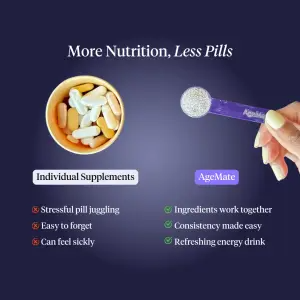
Using the attached image as the layout reference: keep the dark purple gradient background with a soft glow in the centre, a centred white headline with the second half in italics, a product of the old routine on the left and your product in use on the right, a white label box under the left product and a purple label box under the right, and three bullet points beneath each side: red X icons on the left and green check icons on the right. Replace the left image with {THE OLD WAY} and the right image with {YOUR PRODUCT IN USE}. Set the headline to "{MORE OF THE GOOD}, {LESS OF THE BAD}", the labels to "{THE OLD WAY}" and "{YOUR BRAND}", and the bullets to "{THREE PAIN POINTS}" and "{THREE BENEFITS}".Reference 9
AI Edit Master Prompt
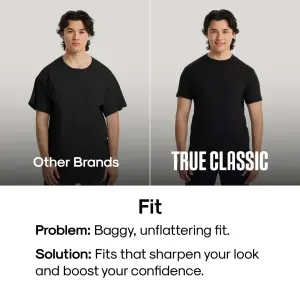
Using the attached image as the layout reference: keep the two side-by-side photos of the same model against a light grey backdrop, wearing the competitor's product on the left and yours on the right, with the same neutral expression in both, a white label on the lower part of each photo, and a white section below with a bold one-word category heading and two lines of text, each starting with a bold label. Replace the model's clothing with {GENERIC ALTERNATIVE} and {YOUR PRODUCT}. Set the labels to "Other Brands" and "{YOUR BRAND}", the heading to "{THE DIFFERENCE}", and the lines to "Problem: {THE PAIN}" and "Solution: {THE PAYOFF}".Reference 10
AI Edit Master Prompt
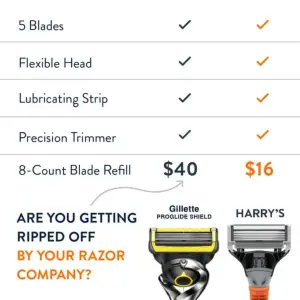
Using the attached image as the layout reference: keep the white background with a four-row feature table at the top, a feature name on the left and two columns of checkmarks on the right (dark for the competitor, orange for you), a price row beneath with two large prices, and a bottom section with a bold caps hook on the left, a hand-drawn arrow pointing right, and two product heads side by side with their names above them. Replace the product heads with {THE ALTERNATIVE} and {YOUR PRODUCT}. Set the features to "{FOUR SHARED FEATURES}", the price row to "{THE PRODUCT BEING PRICED}", the prices to "{THEIR PRICE}" and "{YOUR PRICE}", the names to "{THE ALTERNATIVE}" and "{YOUR BRAND}", and the hook to "{THE PRICE QUESTION}".
(Use a generic alternative unless the named comparison has legal sign-off, and avoid a disparaging hook like "ripped off.")
Reference 11
AI Edit Master Prompt
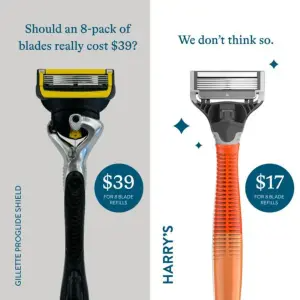
Using the attached image as the layout reference: keep the vertical split with a light grey left half and a white right half, a question headline at the top of the left side and a short answer at the top of the right, the alternative product standing tall on the left and your product standing tall on the right with small sparkle graphics, a dark teal circle with a price and small caption on each side, and a vertical side label running along the bottom edge of each half. Replace the products with {THE ALTERNATIVE} and {YOUR PRODUCT}. Set the question to "{SHOULD IT REALLY COST THIS?}", the answer to "{THE SHORT ANSWER}", the circles to "{THEIR PRICE}" and "{YOUR PRICE}", and the side labels to "{THE ALTERNATIVE}" and "{YOUR BRAND}".
(Name a competitor only with legal sign-off; the price comparison has to be accurate and like-for-like.)
Reference 12
AI Edit Master Prompt
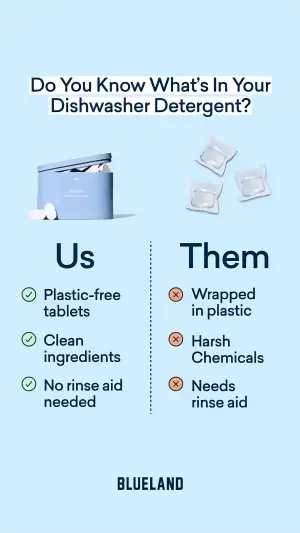
Using the attached image as the layout reference: keep the light blue background, a two-line question headline in dark navy at the top, your product on the left and the competitor's product on the right, large "Us" and "Them" headings with a dotted vertical line between them, three green check items under "Us" and three orange X items under "Them", and a small caps logo at the bottom centre. Replace the products with {YOUR PRODUCT} and {THE GENERIC ALTERNATIVE}, and the logo with {YOUR LOGO}. Set the headline to "{THE QUESTION}" and the lists to "{THREE BENEFITS}" and "{THREE PROVABLE DRAWBACKS}".Reference 13
AI Edit Master Prompt
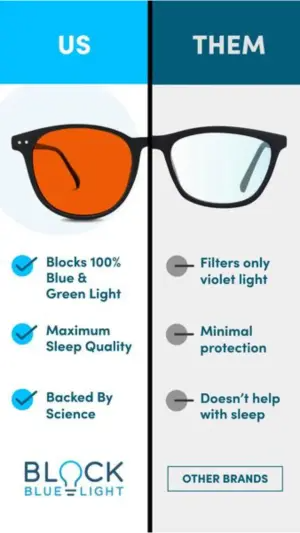
Using the attached image as the layout reference: keep the vertical split with a bright blue "US" header on the left and a dark teal "THEM" header on the right, a single product cut down the middle so your half sits on a light blue background and theirs on light grey, three blue check items down the left and three grey dash items down the right, your logo at the bottom left and an outlined box reading "OTHER BRANDS" at the bottom right. Replace the product with {YOUR PRODUCT} on the left and {THE GENERIC ALTERNATIVE} on the right, and the logo with {YOUR LOGO}. Set the lists to "{THREE BENEFITS}" and "{THREE PROVABLE DRAWBACKS}".Reference 14
AI Edit Master Prompt
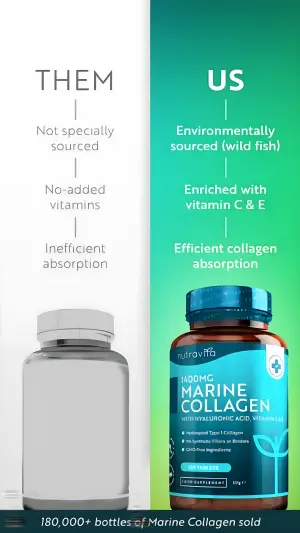
Using the attached image as the layout reference: keep the vertical split with a plain white-to-grey left side headed "THEM" in thin grey caps and a green-to-blue gradient right side headed "US" in white caps, a thin vertical tree line on each side connecting three short points, a blank, unlabelled grey bottle at the bottom left and your vibrant labelled bottle at the bottom right, and a dark strip along the bottom with a single italic white line. Replace the right bottle with {YOUR PRODUCT} and the gradient with {YOUR BRAND COLORS}. Set the points to "{THREE PROVABLE DRAWBACKS}" and "{THREE BENEFITS}", and the bottom line to "{YOUR REAL SALES NUMBER}".Reference 15
AI Edit Master Prompt
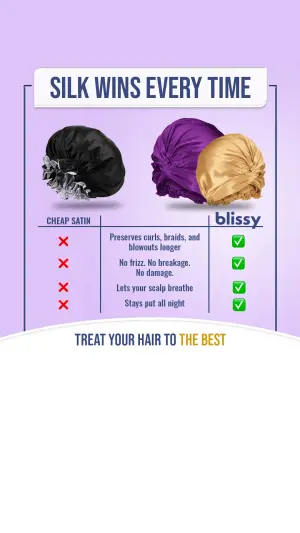
Using the attached image as the layout reference: keep the light lilac background, a white banner with a bold navy caps headline framed by thin lines, the alternative product on the left and your product on the right, a feature table beneath with a small caps label over the left column and your logo over the right, a central column of feature text, red X icons down the left and green check icons down the right, and a white section at the bottom with a caps closing line where the last words are in gold. Replace the products with {THE GENERIC ALTERNATIVE} and {YOUR PRODUCT}, and the logo with {YOUR LOGO}. Set the headline to "{WHY YOU WIN}", the left label to "{THE ALTERNATIVE}", the features to "{FOUR BENEFITS}", and the closing line to "{THE SWITCHING LINE}".Reference 16
AI Edit Master Prompt
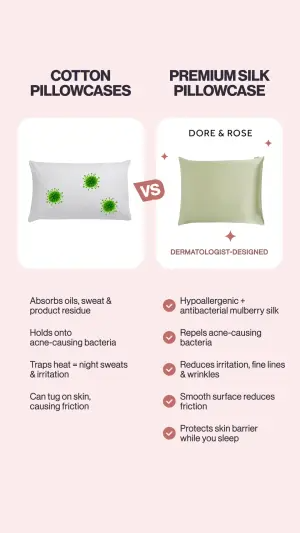
Using the attached image as the layout reference: keep the soft pink background, two bold caps headings side by side, two white rounded cards (the alternative product on the left with green bacteria graphics, your product on the right with a small logo, sparkles and a small caps badge) joined by a round "VS" badge in the middle, and two lists below: plain text points on the left and pink check-icon points on the right. Replace the left product with {THE GENERIC ALTERNATIVE}, the right product with {YOUR PRODUCT}, and the logo with {YOUR LOGO}. Set the headings to "{THE ALTERNATIVE}" and "{YOUR PRODUCT}", the badge to "{YOUR CREDENTIAL}", and the lists to "{FOUR PROVABLE DRAWBACKS}" and "{FIVE BENEFITS}".Reference 17
AI Edit Master Prompt
Produce a 33s vertical 9:16 POV ad for True Classic fitted t-shirts. No dialogue.

Generate the following sequence:

The Introduction: First-person POV holding the True Classic packaging against a modern, bright lifestyle background.

The Preparation: Quick jump cuts of a hand opening the packaging and revealing the sleek t-shirt.

The Fit: Fast cut to the shirt being worn, highlighting how it hugs the arms and chest while remaining loose around the midsection.

The Final Look: A steady shot of the wearer standing confidently against the background to emphasize the flattering fit.

Assemble: Fast-paced jump cuts. Focus on the unboxing and visually appealing fit to establish a premium, confident vibe.

Text Overlay: Static "UPGRADE YOUR FIT TODAY" banner at the top of the screen throughout.

Audio: Upbeat, trendy instrumental beat driving the cuts. No voiceover.

End Card: Concludes naturally on the final lifestyle shot of the fitted t-shirt.